
The Worrier Brain: The ADHD Look-Alike Nobody Talks About
[republished from Julie Angileri’s Substack]
Everyone knows the ADHD story by now. Too little dopamine, brain chasing stimulation, can’t sit still, can’t focus, needs a stimulant to turn the volume up. It’s had its cultural moment. TikTok has explained it to death.
Nobody’s talking about the opposite version
The one that can look almost identical from the outside — trouble switching tasks, getting stuck in loops, procrastinating on things you’re perfectly capable of doing — but runs on the exact opposite wiring. Too much dopamine, not too little. And treating it like standard ADHD can make it worse.
It’s called the Met/Met genotype, on a gene called COMT, and researchers gave it a nickname that actually holds up: warrior vs. worrier.
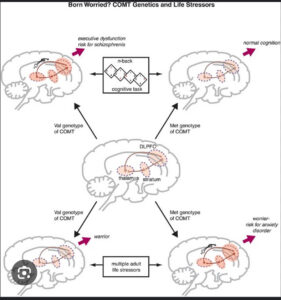
Here’s the short version. COMT is the enzyme that clears dopamine out of your prefrontal cortex — the part of your brain doing the thinking, planning, and impulse control. Some people clear it fast. Some people clear it slow. The slow clearers are the Met/Met group, and their brain’s thinking center runs at a higher baseline level of dopamine all the time. Think of it as a sports car engine instead of a sedan. Great horsepower for thinking. Also revs high, which means everything gets felt more intensely, and the whole system floods faster under stress.
The Val/Val group — the “warriors” — clear dopamine fast. Lower baseline thinking horsepower, but a nervous system built to stay steady under pressure. Neither one is the upgrade. They’re just different tradeoffs, and both were probably useful somewhere back in human history — one version keeps the tribe calm in a crisis, the other version is the one who notices the threat first.
If you’re Met/Met, here’s what that tends to look like in a body:
You can concentrate like a laser and hold a lot in your head at once — genuinely strong working memory, genuinely strong sustained focus, when you’re not under stress. But switching gears is brutal. Once you’re locked into a way of doing something, pivoting away from it costs you more than it costs other people, and you get stuck in loops — turning the same problem over and over instead of moving on, because moving on requires a kind of cognitive flexibility that isn’t your strong suit.
Your alarm system runs hot. Brain imaging shows Met/Met brains light up harder in the amygdala when looking at anything remotely negative — genotype alone explains up to 38% of the difference in that response. Translation: you clock threats, losses, and bad news faster and more intensely than the average brain does, and you don’t get to opt out of that. It’s not a personality flaw. It’s a more sensitive alarm, wired in.
And motivation is its own separate problem. Even though the reward system works — Met/Met brains are actually good at detecting rewards — the ignition switch for starting something without an external deadline is sluggish. You know you’re capable. You know you’ll be great once you’re in it. Getting there feels like pushing a boulder uphill, especially for anything that doesn’t have an immediate payoff attached.
None of that is a character defect. It’s an engine that runs hot and needs a different kind of driving.
And here’s the part that actually matters clinically: if you hand this brain a stimulant, expecting the usual ADHD bump in focus, you can get the opposite. The thinking center’s already got plenty of dopamine on board. Adding more is like topping off a full tank — it overflows, and instead of feeling sharper, you feel foggy, tired, wired-but-flat, or more anxious than you started. That’s not you being “treatment resistant.” That’s the medication working exactly as it should on a brain it wasn’t built for.
From the other side of the desk
I see this constantly, and almost nobody’s heard of it going in. A patient comes to me convinced they’ve failed ADHD treatment because Vyvanse made them anxious and foggy instead of focused, and they’ve usually been told to just try a higher dose. Wrong direction. The pattern to look for isn’t “ADHD that doesn’t respond to stimulants” — it’s a nervous system that’s already running high, getting handed more fuel. What actually helps looks more like anxiety treatment than classic ADHD treatment. Stress management isn’t a nice-to-have here — it’s the foundation. Catch the catastrophizing early, before it ruins the whole afternoon; this brain jumps straight to the worst-case scenario, every time, and it needs to be caught mid-jump. And build the structure into your environment instead of expecting your own flexibility to show up when you need it — timers, checklists, a clear cue for “we’re switching tasks now.” Internal flexibility is the one thing this wiring doesn’t hand you for free, so stop asking it to. If a stimulant made you feel worse instead of better, that’s data, not a failure. It might mean your brain was never the one the medication was built for in the first place.
Next up: the warrior brain.


